
Welcome to the Augmented Environments Lab (AEL) website. We are a group of researchers in the GVU Center at the Georgia Institute of Technology, spanning multiple schools and disciplines, interested in understanding the interplay of technology, design, interactivity and media when directly augmenting a user’s senses with computer generated material.
The lab was founded 1998. We use the term Augmented Environments to emphasize our interest in systems and experiences where the physical environment is an essential element of the experience, and does not merely act as a background for an overlaid computer media experience. From the artifacts in a historic home, to the equipment in a factory, to the people sharing a game around a kitchen table, the places and people are what gives the experience its meaning.
Most of our work is in the area of Augmented Reality (AR), where a media (typically graphics) are spatially registered with a user’s view of the world around them. We also work in the broader space of Mixed Reality (MR), using mobile and wearable devices to create location-based experiences that do not spatially integrate media with the user’s view of their environment. Our interests lie at many levels: from content and design through interaction techniques and game mechanics. We design, build and evaluate these systems using a range of human-centered computing methodologies.
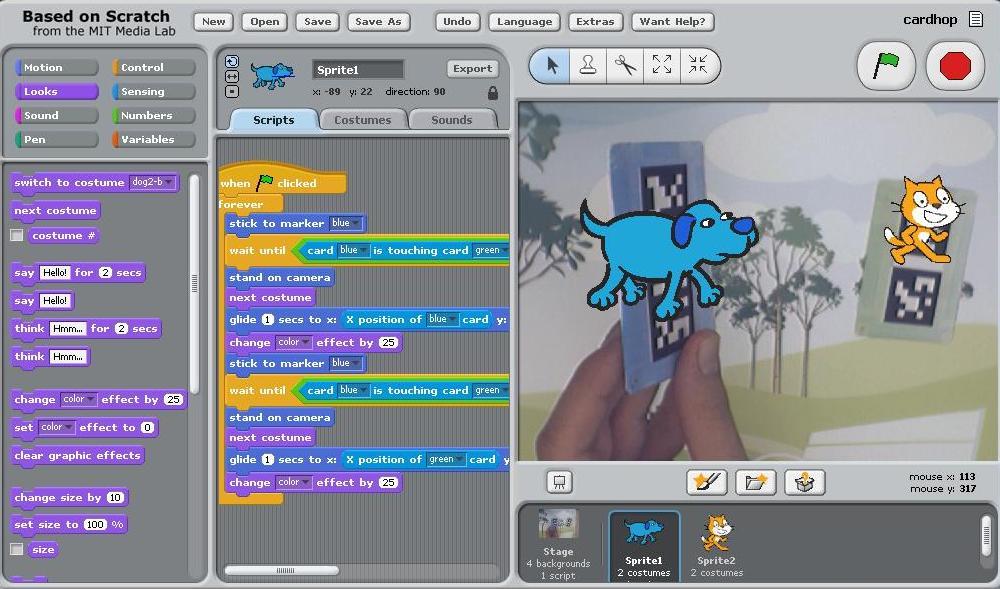
The projects in the lab are usually driven by applications or design problems; we believe that tackling interesting problems (e.g., communication between machinery and workers on poultry processing lines) and design challenges (e.g., exploring multiple viewpoints in an interactive drama) push forward our understanding of the field. To support our work, we build tools to enable non-technologists to work with AR and MR systems, such as allowing designers to use the Director multi-media authoring environment, or game players to experiment with AR in massively multiplayer online worlds such as SecondLife.
Follow our Google+ page for updates.
Recent Comments