
ClearSpace: Mixed-Reality Presence through Virtual ClearBoards

Abstract

A mixed-reality team room project, ClearWorlds aims to support teams that include local members and those working remotely from home offices, hotel rooms, or other off-site locations. To provide equal access to the team room, we’re using a virtual world, developed using the Project Wonderland toolkit, as the primary team space. In the virtual team room, users can create and share spatial organizations of content that persist over time. Our goal is to use mixed-reality techniques to produce a consistent spatial relationship between users and their working documents. We’ve started with a focus on virtual whiteboards, using them as a bridge between the physical and virtual world.
Inspired by Hiroshi Ishii’s concept of the ClearBoard, we’re creating a “clear” interactive whiteboard. We’re experimenting with using avatars in place of video to reconstruct the image of collaborators “behind” the physical drawing surface, and transmitting gaze, gesture, and facial expressions using off-the-shelf face-tracking and gesture-tracking software. We’re exploring a configuration in which we mirror back to the user their own avatar representation, effectively constructing the illusion that the in-room user and the remote collaborators are working side-by-side in the virtual world. Prior work suggests that this “space sharing” technique gives users a greater sense of co-presence, and the approach helps avoid situations where users form separate groups on opposite sides of a whiteboard or wall.

Augmented-Reality Scratch: A children’s Authoring Environment for Augmented-Reality Experiences

Abstract

In this paper we introduced AR Scratch, the first augmented-reality (AR) authoring environment designed for children. By adding augmented-reality functionality to the Scratch programming platform, this environment allows pre-teens to create programs that mix real and virtual spaces. Children can display virtual objects on a real-world space seen through a camera, and they can control the virtual world through interactions between physical objects. This paper describes the system design process, which focused on appropriately presenting the AR technology to the typical Scratch population (children aged 8-12), as influenced by knowledge of child spatial cognition, programming expertise, and interaction metaphors. Evaluation of this environment is proposed, accompanied by results from an initial pilot study, as well as discussion of foreseeable impacts on the Scratch user community.

Project Page

AR SPOT: A Tangible Programming Environment for Children

Full Reference

I. Radu and B. MacIntyre, “Augmented-Reality Scratch: A children’s Authoring Environment for Augmented-Reality Experiences,” Proceedings of the 8th International Conference on Interaction Design and Children, Como, Italy: ACM, 2009, pp. 210-213.

Watercolor Inspired Non-Photorealistic Rendering for AR

Abstract

Non-photorealistic rendering (NPR) is an attractive approach for seamlessly blending virtual and physical content in Augmented Reality (AR) applications. Simple NRP techniques, that use information from a single rendered image, have been demonstrated in real-time AR systems. More complex NRP techniques require visual coherence across multiple frames of video, and typical offline algorithms are expensive and/or require global knowledge of the video sequence. To use such techniques in real-time AR, fast algorithms must be developed that do not require information past the currently rendered frame. This paper presents a watercolor-like NPR style for AR applications with some degree of visual coherence.

Watercolor-like AR. Three virtual objects (a teapot, a cube and a bunny) and several real objects (pens, notes, a bottle and a tissue box) are stylized.

Reference
Jiajian Chen, Greg Turk, Blair MacIntyre, Watercolor Inspired Non-Photorealistic Rendering for Augmented Reality, In Proc. ACM Symposium of Virtual Reality Science and Technology (VRST08), October 2008, Bordeaux, Fracne [pdf]


BragFish paper got accepted by ACE08

Congratulations~ I will attach the full paper and video later.

Abstract:

In this paper, we present our research on social interaction in colocated handheld augmented reality (AR) games. These games are characterized by shared physical spaces which promote physical awareness between players and individual gaming devices which support both public and private information. One result of our exploration of the design and evaluation of such games is a prototype called BragFish. Through BragFish, we aim to investigate the connections between the observed game experience (focusing on social and physical interaction) and the designed affordances of our AR handheld game. Our evaluation of
BragFish shows that most of the 18 players form strategies for social play by leveraging visual, aural and physical cues from the shared space. Moreover, we use this as an example to motivate discussions on how to improve social play experiences for colocated handheld games by designing for shared spaces.

Reference:
Yan Xu, Maribeth Gandy, Sami Deen, Brian Schrank, Kim Spreen, Michael Gorbsky, Timothy White, Evan Barba, Iullian Radu, Jay Bolter, Blair MacIntyre, BragFish: Exploring Physical and Social Interaction in
Co-located Handheld Augmented Reality Games, International conference on Advances in computer entertainment technology, ACM Press, 2008.

An Evaluation of Graphical Context in Registered AR, Non-Registered AR, and Heads-Up Displays

Abstract

An ongoing research problem in Augmented Reality (AR) is to improve tracking and display technology in order to minimize registration errors. However, perfect registration is not always necessary for users to understand the intent of an augmentation. This paper describes the results of an experiment to evaluate the effects of graphical context in a Lego block placement task when the graphics are located outside of the task area. Four conditions were compared: fully registered AR; non-registered AR; a heads-up display (HUD) with the graphics always visible in the field of view; and a HUD with the graphics not always visible in the field of view. The results of this experiment indicated that registered AR outperforms both non-registered AR and graphics displayed on a HUD. The results also indicated that non-registered AR does not offer any significant performance advantages over a HUD, but is rated as less intrusive and can keep non-registered graphics from cluttering the task space.

Reference

Cindy Robertson, Blair MacIntyre, and Bruce Walker. “An Evaluation of Graphical Context in Registered AR, Non-Registered AR, and Heads-Up Displays”  In Proceedings of International Symposium on Augmented and Mixed Reality (ISMAR08), Sept 15-18, 2008, Cambridge, England.  pages-73-76.

Uncertainty Boundary for Complex Objects in AR
Abstract

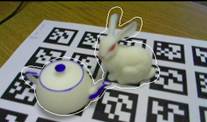
Registration errors between the physical world and computer-generated objects are a central problem in Augmented Reality (AR) systems. Some existing AR systems have demonstrated how to dynamically estimate registration errors based on estimates of spatial errors in the system. Using these error estimates, these systems also demonstrated a number of ways of ameliorating the effects of registration error. One central part of this previous work was the creation and use of error regions around objects; unfortunately, the analytic methods used only created accurate regions for simple convex objects. In this paper, we present a simple and stable algorithm for generating the uncertainty regions for complex objects, including non-convex objects and objects with interior holes. We demonstrate how our approach can be used to create a set of more accurate error-based highlights in the presence of registration error, and also be used as a general highlighting mechanism.

Correct boundary for complex objects: a teapot and bunny

Reference

Jiajian Chen, Blair MacIntyre, Uncertainty Boundary for Complex Objects in Augmented Reality, In Proc of IEEE Virtual Reality (VR08), Reno NV, March 2008 [poster]


An Evaluation of Graphical Context as a Means for Ameliorating the Effects of Registration Error

Abstract

An ongoing research problem in Augmented Reality (AR) is to improve tracking and display technology in order to minimize registration errors. However, perfect registration is not always necessary for users to understand the intent of an augmentation. This paper describes the results of an experiment to evaluate the effects of registration error in a Lego block placement task and the effectiveness of graphical context at ameliorating these effects. Three types of registration error were compared: no error, fixed error and random error. These three errors were evaluated with no context present and some graphical context present. The results of this experiment indicated that adding graphical context to a scene in which some registration error is present can allow a person to effectively operate in such an environment, in this case completing the Lego block placement task with a reduced number of errors made and in a shorter amount of time.

Reference
Robertson, C. and MacIntyre, B. (2007). An Evaluation of Graphical Context as a Means for Ameliorating the Effects of Registration Error. In Proc. International Symposium on Mixed and Augmented Reality, Nara, Japan, November 13-16, pp. 99-110.

Supporting Interaction in Augmented Reality in the Presence of Uncertain Spatial Knowledge

Enylton Machado Coelho, Blair MacIntyre and Simon J. Julier. “Supporting Interaction in Augmented Reality in the Presence of Uncertain Spatial Knowledge” In the Eighteenth Annual ACM Symposium on User Interface Software and Technology (UIST 2005), October 23-26, 2005, Seattle, Washington. [PDF]
Continue reading